Template · Article 50(2) (and 50(4) labelling) · In force since 2 August 2026 (legacy systems: 2 December 2026)
EU AI Act Content Marking: Article 50(2) SOP and Labels
Content marking under Article 50(2) of the EU AI Act (Regulation (EU) 2024/1689) is the duty of providers of generative AI systems to mark synthetic audio, image, video and text in a machine-readable format, so software can detect that the content was artificially generated or manipulated. The duty has applied since 2 August 2026; generative systems already on the market before that date have until 2 December 2026 to comply. It is distinct from the visible deepfake and public-interest-text labels that deployers must add under Article 50(4) — many companies need both.
Last reviewed: 26 August 2026 · In force since 2 August 2026 (legacy systems: 2 December 2026) · Included in the kit as 06_Content_Marking_SOP.docx
What this document is
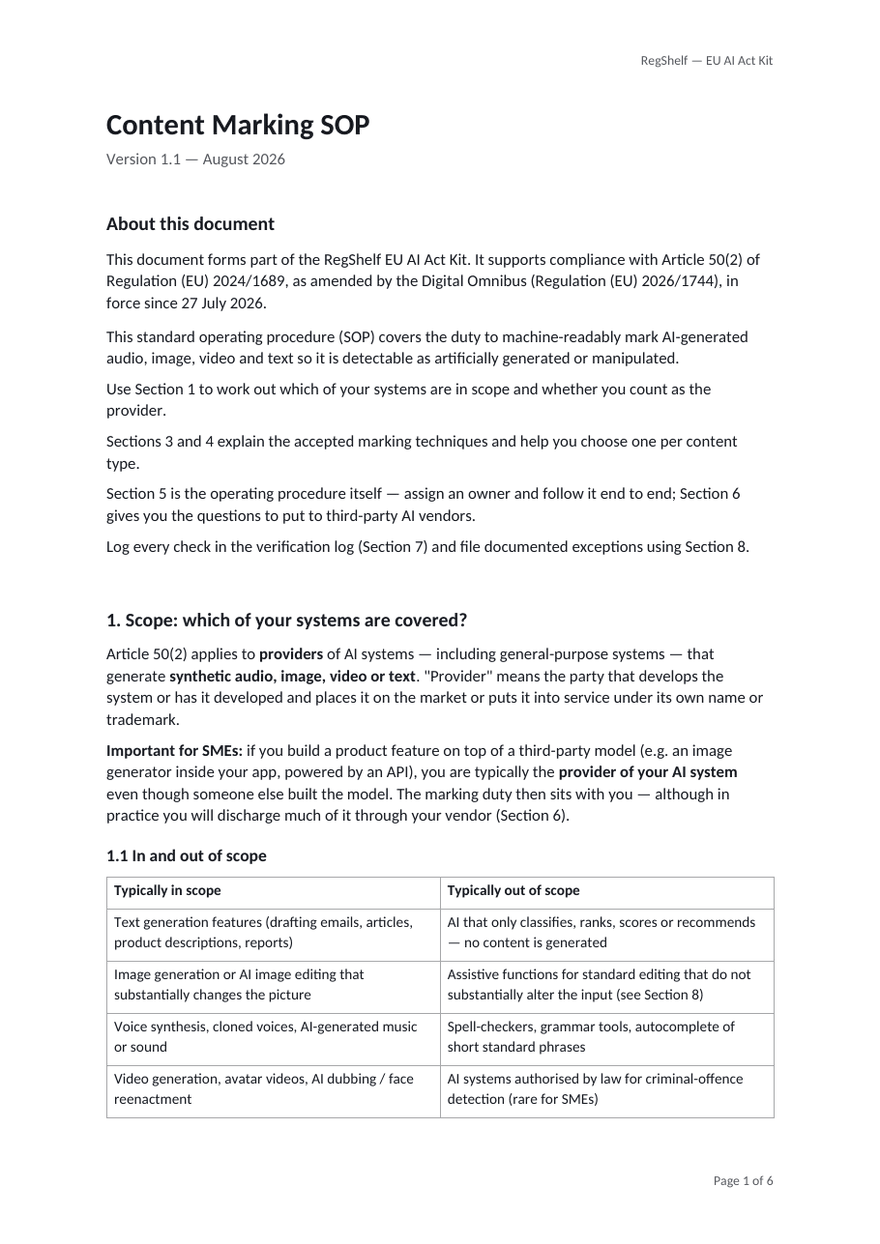
Document 06 of the RegShelf kit is a standard operating procedure for the machine-readable marking duty: scoping, technique selection, implementation, verification and evidence. Its companion, document 07 (Labelling Templates), covers the other side of Article 50 — the visible, human-facing labels deployers must put on deepfakes and on AI-generated text published to inform the public (Article 50(4)), including ready-to-use caption, on-screen, alt-text and pre-roll wording, the lighter regime for artistic and satirical works, and the editorial-responsibility statement for the human-review exemption. The two documents deliberately separate the two duties because the Act does: invisible marks are the provider's job; visible labels are the publisher-deployer's.
Who needs it
Providers of AI systems that generate synthetic content — and that category is wider than SMEs expect. If you build a product feature on top of a third-party model (an image generator inside your app, powered by an API), you are typically the provider of your AI system even though someone else built the model, and the marking duty sits with you — though in practice you discharge much of it through your vendor, which is why the SOP includes a vendor question set. If you merely use a third-party generative tool, you are a deployer: the Article 50(2) marking duty stays with the tool's provider, but the Article 50(4) labelling duties in document 07 can be yours whenever you publish deepfakes or public-interest text.
What the law requires — precisely
Outputs of in-scope systems must be marked machine-readably, and the marking must be effective, interoperable, robust and reliable as far as technically feasible — taking into account the specificities and limitations of the content type, the costs of implementation and the generally acknowledged state of the art. Points SMEs get wrong:
- No SME exemption. Article 50(2) applies to providers of all sizes; cost and state of the art are feasibility factors, not a carve-out.
- Dates: in force and enforceable since 2 August 2026 (fines up to €15 million or 3% of worldwide turnover; SMEs and small mid-caps pay the lower of the two, Article 99(6)); systems placed on the market before 2 August 2026 have until 2 December 2026; new systems must mark from day one.
- The Code of Practice on marking is voluntary. The Commission declared it adequate in July 2026 and following it is the simplest way to demonstrate compliance, but its milestones — such as interoperable marking by February 2027 — are commitments under a voluntary code, not statutory deadlines.
- An exception exists for assistive functions for standard editing that do not substantially alter the input or its meaning — apply it narrowly and document every use.
What's inside the RegShelf templates
The Content Marking SOP (doc 06) contains: a scope section with an in/out table and system inventory; the obligation and dates in plain language; a guide to the four marking technique families — C2PA/Content Credentials provenance metadata, invisible watermarking, fingerprinting/logging, and format-level metadata — with a recommended primary and secondary technique per content type; a five-step procedure (assess, choose, implement, verify, document); seven questions to send every generation vendor; a verification log for sample checks after your full production pipeline; and an exception record for assistive-editing features. The Labelling Templates (doc 07) add the deployer layer: the two-element deepfake test, visible-label requirements (clear, at first exposure, medium-fitted, accessible, persistent through sharing), ready-to-use label texts for images, video and audio, the artistic-works regime, the Part B rules for public-interest text with the editorial-responsibility statement, and a publication decision log.
How to use it
Inventory every feature that generates content (cross-referencing your AI system inventory), decide provider or deployer per feature, and check the grace-period question: on the market before 2 August 2026 means a 2 December 2026 deadline. Enable vendor-side marking first — most large APIs can emit C2PA today — and only build your own where the vendor leaves gaps; then verify samples with an independent tool after compression, resizing and CDN delivery, and log the results. Never strip marks or invite users to. If you publish realistic AI images, cloned voices or AI-written public-interest articles, apply the doc 07 visible labels as well.
Related reading
- Chatbot Disclosure template
- Vendor Due-Diligence Questionnaire template
- Article 50 transparency
- Timeline & deadlines
Frequently asked
Who has to mark AI-generated content under the EU AI Act?+
Providers of AI systems that generate synthetic audio, image, video or text — including a company that builds a generative feature on a third-party model and offers it under its own name. A company that merely uses a third-party generative tool is a deployer: the machine-readable marking duty stays with the tool's provider, though the deployer may owe visible labels under Article 50(4).
Is there an SME exemption from Article 50(2) marking?+
No. Article 50(2) applies to providers of all sizes. The law lets you take technical feasibility, implementation cost and the state of the art into account when choosing how to mark — but that is a feasibility factor, not an SME carve-out.
What is the deadline for marking AI-generated content?+
The duty has applied since 2 August 2026. Generative systems already placed on the market before that date have a transition until 2 December 2026; systems placed on the market after it must mark outputs from day one. The February 2027 interoperability milestone belongs to the voluntary Code of Practice, not the statute.
What is the difference between Article 50(2) marking and Article 50(4) labels?+
Article 50(2) requires providers to embed machine-readable marks (metadata, watermarks) that software can detect. Article 50(4) requires deployers to add visible, human-facing disclosures to deepfakes and to AI-generated text published to inform the public on matters of public interest. They are separate duties on separate roles — many companies carry both.
Primary sources
- Regulation (EU) 2024/1689 (consolidated)
- Commission Guidelines on transparency of AI-generated content (Article 50)
- Regulation (EU) 2026/1744 (Digital Omnibus on AI)
This template ships in the EU AI Act Kit
24 fill-in documents in Word and Excel — launch price €149, twelve months of updates included.
See the full kit