Template · Article 50(1) · In force since 2 August 2026
AI Chatbot Disclosure Template (EU AI Act Article 50(1))
A chatbot disclosure is the notice that tells people they are interacting with an AI system rather than a human. Under Article 50(1) of the EU AI Act (Regulation (EU) 2024/1689), providers must design AI systems that interact directly with natural persons so that those persons are informed they are dealing with AI — clearly, and no later than the first interaction — unless that is already obvious to a reasonably well-informed, observant person. The duty has applied since 2 August 2026; the Commission's Article 50 Guidelines (July 2026) confirm it covers systems enabling a genuine two-way conversational exchange, not every automated message.
Last reviewed: 26 August 2026 · In force since 2 August 2026 · Included in the kit as 05_Chatbot_Disclosure_Kit.docx
What this document is
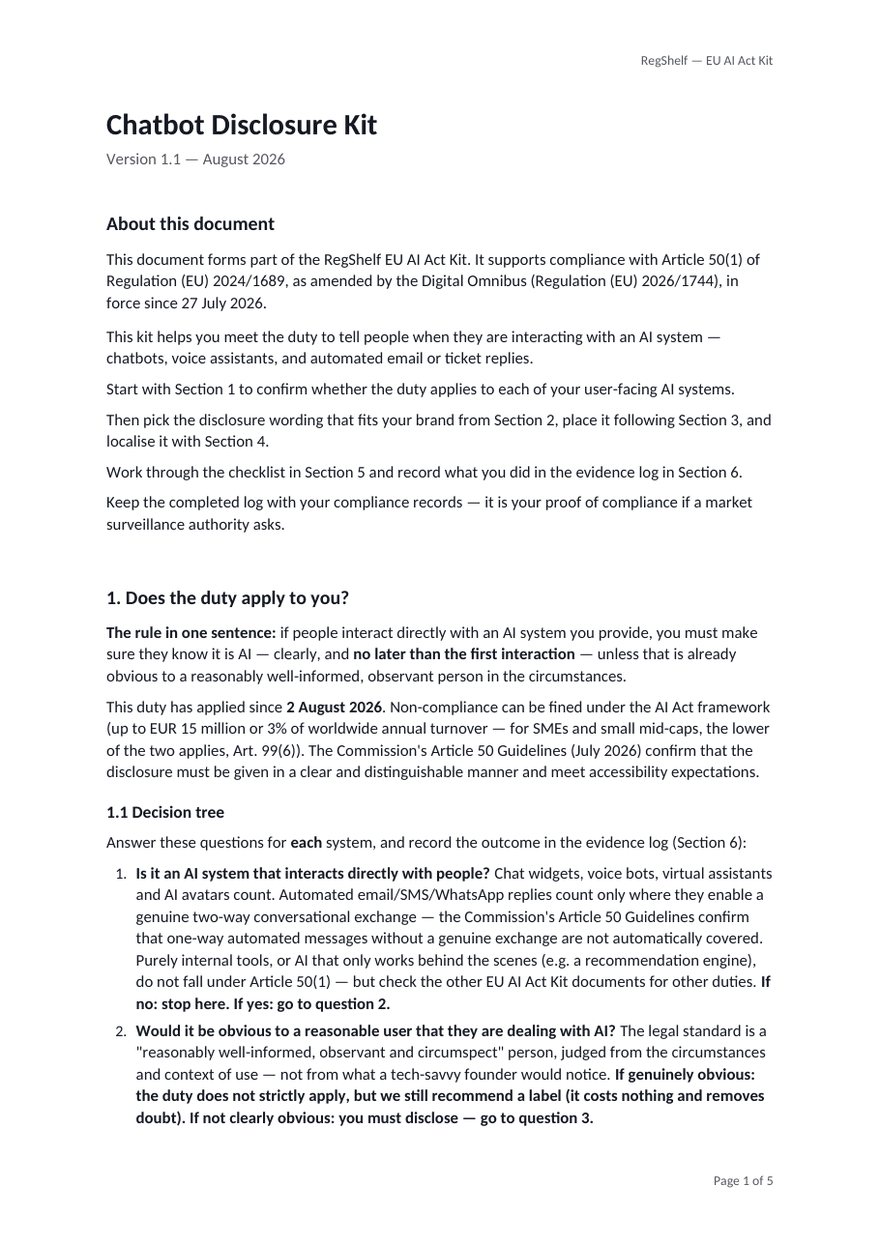
Document 05 of the RegShelf kit gives you everything between "we should probably label the chatbot" and a documented, defensible implementation: a decision tree to confirm whether the duty applies to each system, ready-to-paste disclosure wording in three tones (neutral, friendly, formal) for four channels (chat first message, persistent UI label, voice opening, AI-sent email and ticket replies), placement rules drawn from the Commission's July 2026 Guidelines, approved short-form snippets in five EU languages, an implementation checklist and an evidence log. All three tones meet the legal standard — the choice is brand voice, not compliance level.
Who needs it
Companies that provide user-facing AI: a support chat widget, a voice bot on the phone line, an AI avatar, or automated email and ticket replies that hold a genuine two-way conversation. The kit's worked examples show where the line runs: a fluent web chatbot needs disclosure (modern bots are easily mistaken for humans); a voice bot needs it in the opening sentence; a feature clearly branded "Ask AI" may be obvious, but a label is still recommended; and AI-drafted replies that a staff member reviews, edits and sends under their own name typically do not trigger the duty at all — the customer is interacting with your colleague, not the AI.
What the law requires — precisely
Article 50(1) sits on the provider — it is a design duty. The key parameters, per the Act and the Commission's Article 50 Guidelines of July 2026:
- Scope: AI systems intended to interact directly with natural persons through a genuine bidirectional, conversational exchange. One-way automated messages without a real exchange are not automatically covered.
- Timing: disclosure at the latest at the first interaction — a first bot message that discloses is fine; a line buried in terms of service or an FAQ is not.
- Exceptions: where AI is obvious to a "reasonably well-informed, observant and circumspect" person judged from the circumstances (not from what a tech-savvy founder would notice), and a narrow law-enforcement exemption that almost never applies to an SME product.
- Not required: a persistent label kept visible throughout long conversations. That is recommended practice — the template says so explicitly — beyond the strict legal duty.
Non-compliance falls in the fines framework of up to €15 million or 3% of worldwide annual turnover; for SMEs and small mid-caps the lower of the two applies (Article 99(6)).
What's inside the RegShelf template
Six sections:
- Does the duty apply? — a three-question decision tree plus a table of five worked situations and a border-case rule (if you are debating whether it is obvious, disclose);
- Ready-to-paste copy — twelve disclosure texts covering chat first messages, persistent UI labels, voice openings and email/ticket lines, each in neutral, friendly and formal variants;
- Placement guidance — timing, visibility, voice channels, accessibility (screen-reader equivalents, spoken disclosure), language matching and human-handover rules;
- Multilingual snippets — approved wording in English, German, French, Spanish and Italian for all four placements;
- A ten-step implementation checklist and an evidence log — one row per system and channel, with dated screenshots or recordings, so you can show a market surveillance authority exactly what was live when.
How to use it
List every channel where people interact with your AI, run each through the decision tree, pick one tone, and paste the wording into the first bot message, voice opening and AI-sent replies. Localise into every interface language, verify accessibility, then screenshot each disclosure and file it in the evidence log with a six-month re-check reminder. If your AI also generates published content, pair this kit with the content marking SOP — disclosure and marking are separate Article 50 duties.
Related reading
- AI Content-Marking SOP template
- Internal AI-Use Policy template
- Article 50 transparency
- Timeline & deadlines
Frequently asked
Do I have to tell customers they are talking to a chatbot?+
If you provide an AI system that interacts directly with people, yes — Article 50(1) requires them to be informed clearly and at the latest at the first interaction, unless it is already obvious to a reasonably well-informed, observant person. The duty has applied since 2 August 2026.
Do automated email replies need an AI disclosure?+
Only where they enable a genuine two-way conversational exchange. The Commission's Article 50 Guidelines confirm that one-way automated messages without a genuine exchange are not automatically covered. AI-drafted replies that a human reviews and sends under their own name typically fall outside the duty — document the review step.
What should an AI chatbot disclosure say?+
Something as simple as: "You are chatting with an AI assistant operated by [Company]. You can ask for a human colleague at any time." It must be clear, given no later than the first interaction, in the language of the interface, and accessible — not hidden in terms of service.
Does the disclosure have to stay visible during the whole conversation?+
No — the strict legal duty is clear disclosure at the latest at first interaction. Keeping a persistent label or AI-branded avatar visible through long conversations is recommended practice that removes doubt, but it goes beyond what Article 50(1) requires.
Primary sources
- Regulation (EU) 2024/1689 (consolidated)
- Commission Guidelines on transparency of AI-generated content (Article 50)
- Regulation (EU) 2026/1744 (Digital Omnibus on AI)
This template ships in the EU AI Act Kit
24 fill-in documents in Word and Excel — launch price €149, twelve months of updates included.
See the full kit