Template · Articles 14 and 26 · Applies with the high-risk regime from 2 December 2027 (Annex III)
Human Oversight Template for the EU AI Act (Article 14)
Human oversight under Article 14 of the EU AI Act (Regulation (EU) 2024/1689) means high-risk AI systems must be designed and developed so that natural persons can effectively oversee them in use, to prevent or minimise risks to health, safety and fundamental rights; Article 26 adds the deployer's side — assigning oversight to people with the necessary competence, training, authority and support. A human oversight SOP is the document that records both layers: the measures built into the system by the provider and the measures the deployer implements in operation. These duties apply with the high-risk regime, from 2 December 2027 for Annex III systems.
Last reviewed: 26 August 2026 · Applies with the high-risk regime from 2 December 2027 (Annex III) · Included in the kit as 18_Human_Oversight_SOP.docx
What this document is
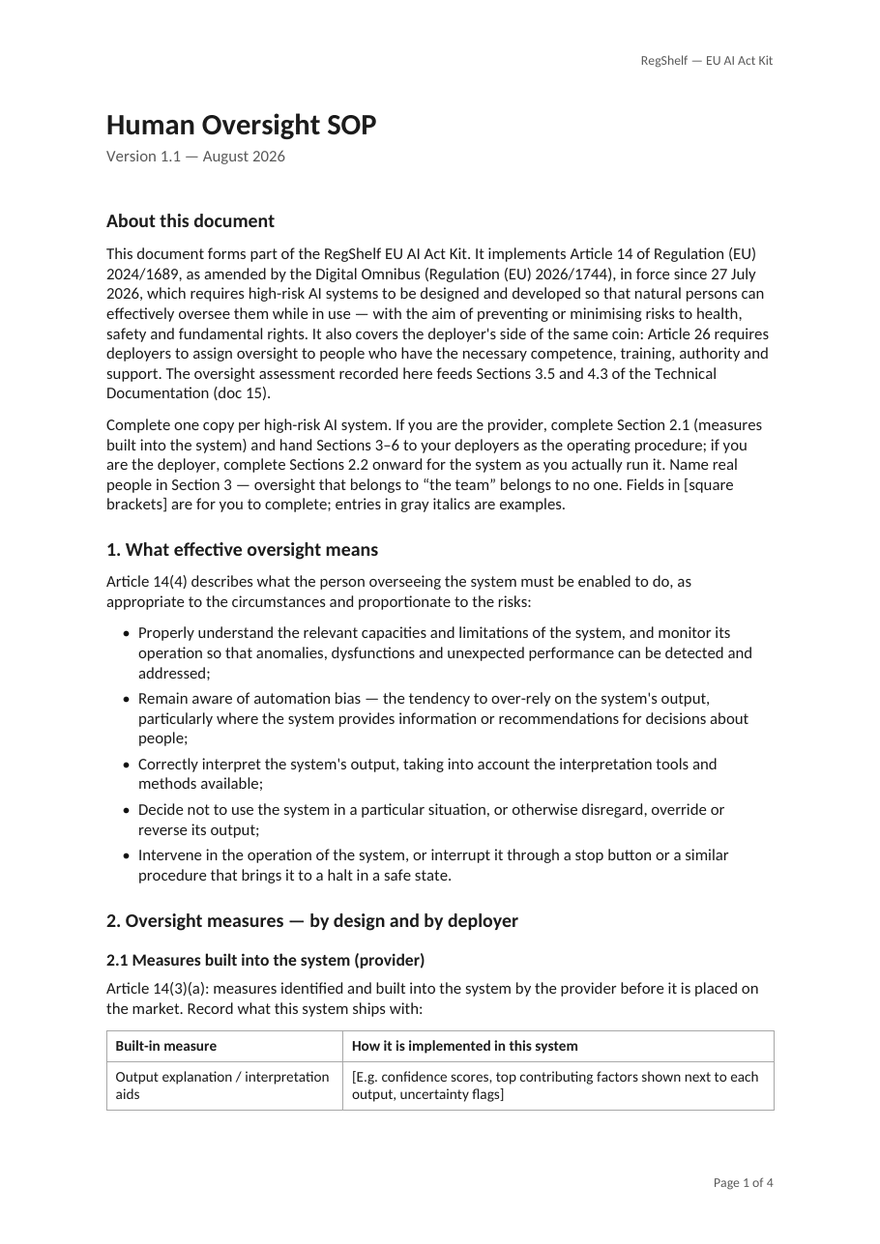
Document 18 of the RegShelf kit is a standard operating procedure completed once per high-risk AI system, designed to work from either side of the provider/deployer split: a provider completes the built-in-measures section and hands the operational sections to its deployers; a deployer completes the operational sections for the system as actually run. Its governing principle is stated bluntly: name real people — oversight that belongs to "the team" belongs to no one. The completed assessment feeds directly into Sections 3.5 and 4.3 of the Annex IV technical documentation (doc 15).
Who needs it
Providers of high-risk AI systems, who must build oversight measures into the system before market placement (Article 14(3)(a)) and identify the measures deployers should implement (Article 14(3)(b)); and deployers of high-risk systems, who must assign oversight to natural persons with competence, training, authority and support (Article 26). For an SME deploying, say, a vendor CV-screening tool, this SOP is where "a human checks the output" becomes something an authority would recognise: named operators, defined override authority, a log, and countermeasures against rubber-stamping.
What the law requires — precisely
Article 14(4) describes what the overseeing person must be enabled to do, as appropriate to the circumstances and proportionate to the risks:
- properly understand the system's relevant capacities and limitations and monitor its operation, so anomalies, dysfunctions and unexpected performance can be detected and addressed;
- remain aware of automation bias — the tendency to over-rely on the system's output, particularly for decisions about people;
- correctly interpret the output, using the interpretation tools available;
- decide not to use the system in a particular situation, or disregard, override or reverse its output;
- intervene in its operation or interrupt it through a stop button or similar procedure that halts it in a safe state.
For remote biometric identification systems (Annex III point 1(a)), no action may be taken on an identification unless it is separately verified by at least two competent persons, unless Union or national law provides otherwise for law enforcement, migration or border control. A template records and operationalises these duties; the design obligation itself sits in the system.
What's inside the RegShelf template
Six sections and five tables:
- What effective oversight means — the Article 14(4) capabilities in plain language;
- Two-layer measures tables — built into the system by the provider (interpretation aids, anomaly and drift alerts, override controls, stop mechanism, action logging) and implemented by the deployer (review points, sampling of accepted outputs, four-eyes rule, the two-person verification rule for remote biometric identification);
- Named authority table — operator, oversight lead and management, each with explicit intervention rights, plus the rule that overriding in good faith must never disadvantage the person doing it;
- Competence and automation-bias countermeasures — training prerequisites tied to the kit's literacy programme, outputs presented as proposals with confidence and factors, stated reasons for agreement in high-impact cases, override-rate monitoring (a near-zero rate is treated as a warning sign of rubber-stamping, not proof of quality), blind-review rotation, and realistic workload;
- An oversight log with worked example entries (an override for a parental-leave career gap; a pause after a vendor update shifted score distributions), and a three-level escalation path ending in Article 73 serious-incident reporting — immediately and no later than 15 days after awareness, 2 days for widespread infringement or serious and irreversible critical-infrastructure disruption, 10 days in the event of a death.
How to use it
Complete one copy per high-risk system, from the side of the split you occupy. Name individuals, not roles-in-the-abstract; train them per the competence section before they take oversight duty; and review the log monthly — it is deployer-side evidence that oversight is real. Feed the completed assessment into your Annex IV technical documentation, and where you owe a FRIA, mirror the same measures in its oversight section. Nothing in the SOP prevents anyone from stopping the system immediately where people are at risk: stop first, escalate second.
Related reading
- Fundamental Rights Impact Assessment (FRIA) template
- Annex IV Technical Documentation template
- Timeline & deadlines
- Article 50 transparency
Frequently asked
What does the EU AI Act require for human oversight?+
High-risk systems must be designed so natural persons can effectively oversee them (Article 14): understand capacities and limits, monitor operation, stay aware of automation bias, correctly interpret outputs, decide not to use or to override the system, and intervene or stop it safely. Deployers must assign that oversight to people with competence, training, authority and support (Article 26).
Does a human have to review every AI decision?+
Article 14 does not prescribe review of every output — measures must be appropriate to the circumstances and proportionate to the risks. What matters is that oversight is effective: the right outputs are reviewed at the right points, the overseer can genuinely deviate, and separately, GDPR Article 22 restricts solely automated decisions with legal or similarly significant effects unless an exception with safeguards applies.
What is automation bias and why does the AI Act mention it?+
Automation bias is the tendency to over-rely on a system's output — waving scores through under workload pressure. Article 14(4)(b) requires overseers to remain aware of it. Practical countermeasures in this template: outputs shown as proposals with reasons, required reasoning for agreement in high-impact cases, override-rate monitoring, and blind-review sampling.
When do the human oversight obligations apply?+
With the high-risk regime: from 2 December 2027 for Annex III systems and from 2 August 2028 for AI in Annex I Section A products. Designing oversight late is expensive — providers should build the Article 14 measures in during development, and deployers should pilot the operating procedure well before the deadline.
Primary sources
- Regulation (EU) 2024/1689 (consolidated)
- AI Act Explorer — Article 14 (human oversight)
- Regulation (EU) 2026/1744 (Digital Omnibus on AI)
This template ships in the EU AI Act Kit
24 fill-in documents in Word and Excel — launch price €149, twelve months of updates included.
See the full kit